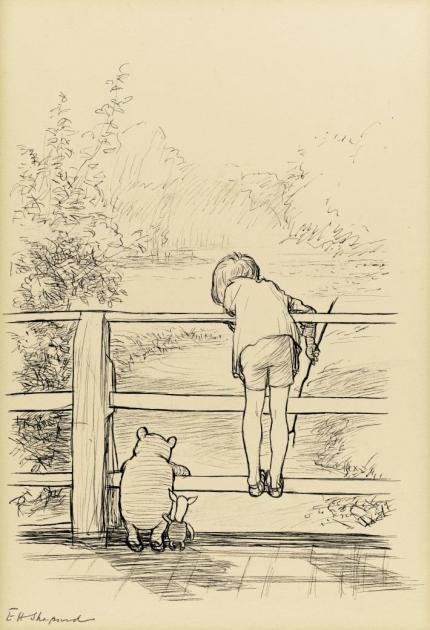
Walk into any bookstore, library, or childhood memory, and you’re likely to encounter the indelible mark of E.H. Shepard. His unique talent, the very essence of E.H. Shepard's Iconic Illustrations & Artistic Style, breathed life into some of the most cherished characters in English literature, making them real in a way words alone could never quite capture. From the gentle melancholia of Eeyore to the rambunctious joy of Toad, Shepard’s visual storytelling transformed classic tales into universal experiences, etching them into our collective consciousness.
For over a century, his pen-and-ink drawings have been the definitive window into the worlds of Winnie-the-Pooh and The Wind in the Willows, defining generations of readers' perceptions. But Shepard’s journey was far richer and more complex than just two beloved books; it was a testament to resilience, a quiet revolution in children's illustration, and a lifelong dedication to the craft.
At a Glance: E.H. Shepard's Enduring Legacy
- Early Life & Influences: Born in London in 1879, Shepard's artistic path was shaped by a family of artists and architects, and significantly influenced by John Tenniel's detailed engravings.
- A Painter's Pivot: Despite initial aspirations as a painter, Shepard found his true calling and confidence in illustration and cartooning, contributing extensively to Punch magazine.
- The Hundred Acre Wood: His defining collaboration with A.A. Milne for Winnie-the-Pooh and its sequels created characters that became global icons.
- Making Animals "Real": Shepard's distinctive style rendered anthropomorphic animals with a profound sense of authenticity and individual personality, a quality deeply appreciated by authors like Kenneth Grahame.
- Beyond Pooh: He illustrated dozens of other books, including his personal favorite, The Wind in the Willows, showcasing a versatility often overshadowed by his most famous bear.
- A Complex Legacy: While globally celebrated, the Pooh illustrations brought both fame and frustration, leading to financial and personal challenges for both Shepard and the Milne family.
- Timeless Appeal: His gentle humor, meticulous line work, and ability to evoke emotion ensure his illustrations remain cherished, even amidst modern interpretations and "Disneyfication."
The Man Behind the Magic: Ernest Howard Shepard's Formative Years
Ernest Howard Shepard, affectionately known as E.H. Shepard, began his life in London in 1879, born into a family steeped in creativity. His father, Henry Shepard, was an architect, and his mother, Jessie, was the daughter of renowned watercolorist William Lee. This lineage undoubtedly sowed the seeds of his artistic inclination. The early loss of his mother when he was just ten years old likely instilled a quiet thoughtfulness that would later inform the gentle empathy in his drawings.
Shepard pursued formal art education, first at St. Paul's, then the Heatherley School of Fine Art from 1897 to 1902, before earning a scholarship to the prestigious Royal Academy Schools. It was here that he honed his technical skills and began to cultivate his distinctive hand. A crucial early influence was the work of John Tenniel, whose detailed and expressive engravings for Alice's Adventures in Wonderland set a high bar for literary illustration. This early exposure to Tenniel's precision and character-driven artistry would echo throughout Shepard's own career.
At the Royal Academy, he met Florence Chaplin, a fellow artist who would become his wife in 1904. Their early years involved a blend of artistic pursuits and domesticity, moving to Shamley Green in Surrey and welcoming two children, Graham and Mary, who would later become illustrators themselves – Mary famously for Mary Poppins.
From Canvas to Cartoon: Forging a Path in Illustration
While Shepard initially harbored ambitions as a painter, even seeing works accepted by the Royal Academy in 1904 and the Paris Salon, he grappled with insecurity about his oil painting skills. This self-doubt ultimately led him to pivot, a decision that would serendipitously redefine his career. He never publicly displayed his paintings again, instead turning his prodigious talent towards illustration, a medium where his unique strengths truly shone.
He began his journey as a commercial artist by contributing humorous cartoons and illustrations to a variety of popular magazines of the era, including The Illustrated London News, London Opinion, and the venerable Punch. His first two drawings for Punch were accepted in 1907, marking the beginning of a long and fruitful relationship with the publication. Beyond magazines, Shepard also lent his illustrative touch to several classic books, such as Tom Brown’s Schooldays, David Copperfield, Henry Esmond, and Aesop’s Fables, demonstrating his versatility long before his most famous commissions.
The quiet pursuit of art was dramatically interrupted in 1914 with the outbreak of World War I. Shepard enlisted in the Royal Artillery, serving four harrowing years with the 105 Siege Battery. He endured the brutal realities of battle at the Somme, Arras, the Third Battle of Ypres, Passchendaele, and later in Italy. Despite the horrors, his artistic impulse persisted; he sketched combat fields for the Intelligence Department and even continued to regularly submit ideas to Punch. His bravery was recognized with a Military Cross, and he retired as a Major. Tragically, the war also brought personal loss, as his elder brother perished at the Somme.
The "Table" at Punch: A Dream Realized
Returning from the war, Shepard was offered a full-time position on the revered "table" at Punch magazine – a dream job that offered both a stable income and a heartwarming connection to his wife's grandfather, Ebenezer Landells, one of the magazine's founders. He became a permanent member of the editorial cartoonist staff in 1921, eventually rising to political cartoonist in 1933. This promotion, however, brought a slight internal conflict for Shepard, who often felt his inherently gentle and warm artistic style was not ideally suited for the sharper, often satirical demands of political caricature. Nevertheless, he persevered, succeeding Leonard Raven Hill as "Second Cartoonist" in 1935 and ultimately Bernard Partridge as "Senior Cartoonist" in 1945.
Shepard’s contributions to Punch were lauded for their "distinguished use of movement," whether in a single-panel gag or occasional multi-panel sequential strips like 'The Testing of a Patriot' (1915). His ability to convey narrative and emotion with expressive lines was evident even in these early works. He remained a fixture at Punch for decades, also illustrating Jan Struther's The Modern Struwwelpeter (1936), until his departure in 1953 under the new editor, Malcolm Muggeridge.
The Hundred Acre Collaboration: Bringing Pooh to Life
It was within the vibrant, intellectual ecosystem of Punch that Shepard's most pivotal collaboration began. A.A. Milne, a fellow contributor, submitted a collection of children's verses, When We Were Very Young, to Methuen in 1923. E.V. Lucas, a Methuen chairman and Milne's colleague at Punch, saw the potential and recommended that Punch publish some of the verses, specifically suggesting Shepard as the ideal illustrator.
Shepard illustrated eleven of Milne's verses for Punch between January and June 1924. Milne was so profoundly impressed by Shepard's ability to capture the spirit and innocence of his poems that he promptly invited him to illustrate the entire book. When We Were Very Young (1924) became an unexpected, runaway success, reprinted four times within its first year. The stage was set for a phenomenon.
Milne's inspiration for the stories that would follow came directly from his son, Christopher Robin Milne, and the boy's beloved nursery toys. The family's Cotchford Farm in Sussex, purchased in 1925, and the nearby Ashdown Forest, became the real-world muse for the Hundred Acre Wood. Christopher's teddy bear, initially named Edward Bear, transformed into Winnie-the-Pooh – a name borrowed from a real Canadian black bear, "Winnie," at the London Zoo, and a pet swan, "Pooh." Other toys, including a stuffed donkey, a piglet, Kanga, and Roo, also found their places in the narratives. Owl and Rabbit were Milne's original creations, and Shepard cleverly rendered them with a more naturalistic, yet still characterful, touch.
Crucially, Shepard’s design for Pooh was inspired not by Christopher Robin’s bear, but by his own son Graham’s teddy bear, Growler. To truly immerse himself in the world he was bringing to life, Shepard visited Cotchford Farm, observing the Ashdown Forest area, which directly influenced his depictions of the Hundred Acre Wood. He even designed the iconic map of the fictional wood, helping readers visualize its enchanting layout.
The Winnie-the-Pooh quartet was published by Methuen: Winnie-the-Pooh (1926), Now We Are Six (1927), and The House at Pooh Corner (1928), completing the set begun with When We Were Very Young. Crucially, Shepard’s original illustrations were maintained in all global editions, solidifying his visual interpretation as definitive. The collaboration between Milne and Shepard is universally regarded as a "finest example of a successful collaboration," a perfect marriage of text and image. You can delve deeper into the classic Winnie the Pooh stories and their rich history.
More Than Just Pooh: The Bittersweet Legacy and The Wind in the Willows
Despite the global adoration and immense success of the Winnie-the-Pooh series, the phenomenon brought a certain bitterness for both creators. Milne, who considered himself a serious playwright and poet, felt unjustly pigeonholed as solely a children's writer, his subsequent works often overshadowed by Pooh's colossal fame. His son, Christopher Robin, also suffered, feeling exploited and enduring bullying at school, leading to a strained relationship with his father that lasted over three decades.
Shepard, too, faced frustrations. He felt that his Pooh illustrations, while celebrated, unfairly overshadowed his extensive and varied body of work, such as his illustrations for E.V. Lucas’ Playtime and Company. Adding to his woes, Shepard had accepted a flat fee for the Pooh books instead of royalties. This meant that despite their immense popularity, he had to continue drawing and selling Pooh-related artwork throughout his life to generate income, a necessity made more acute after the death of his wife Florence in 1927.
Yet, even amidst these challenges, Shepard found immense joy and creative fulfillment in other projects. In 1931, he received an invitation from Kenneth Grahame, author of The Wind in the Willows, to illustrate his enduring classic. Shepard considered this commission even more exciting than Pooh, partly because Grahame had famously rejected several previous illustrators, deeming their characterizations as "puppets." Shepard took great care, meeting Grahame in person and touring the real-life inspirations for the story – the forest and river settings near Pangbourne, on the Thames. Grahame’s ultimate approval of Shepard’s initial line drawings, with the resounding comment, "I'm glad you made them real," was a profound validation for the illustrator, shortly before the author’s death. These illustrations for The Wind in the Willows remained Shepard's personal favorites.
Throughout the 1930s, Shepard remained incredibly prolific, illustrating fourteen books, designing countless dust jackets and frontispieces, all while maintaining his demanding contributions to Punch. His daughter, Mary, followed in his footsteps, marrying Punch editor E.V. Knox in 1937 and becoming a celebrated illustrator herself, most famously for the original Mary Poppins books (1934).
Shepard's Distinctive Artistic Style: A Closer Look
E.H. Shepard's artistic style is instantly recognizable, yet deceptively simple. It’s a masterclass in economy of line, warmth of character, and a profound empathy for his subjects, animal or human.
The Expressive Power of Line Work
Shepard was a master of line. His pen-and-ink drawings are characterized by delicate, yet firm, strokes that capture an astonishing amount of emotion and movement with minimal fuss. He eschewed overly ornate detail, focusing instead on the essential contours and gestures that define a character or scene. This precision, likely influenced by John Tenniel’s engraving work, allowed for incredible expressiveness. Think of Eeyore’s drooping posture, Pooh’s contemplative stance, or Toad’s exuberant leaps – each is defined by the fluidity and direction of Shepard’s lines. He conveyed textures, from Pooh's fuzz to Badger's bristly coat, through subtle variations in his linework.
Embodying Character: Making Animals Real
Perhaps Shepard’s greatest triumph was his ability to imbue anthropomorphic animals with such profound authenticity and relatable personality. Grahame's "I'm glad you made them real" comment perfectly encapsulates this skill. His Pooh isn't just a teddy bear; he's a slightly clumsy, deeply philosophical friend. His Eeyore is truly melancholic, his Piglet timid, and his Tigger ebullient. For The Wind in the Willows, Shepard didn't just draw animals in clothes; he captured the essence of Ratty's amiable practicality, Mole's gentle curiosity, and Toad's magnificent, often misguided, enthusiasm. He understood animal anatomy enough to make their human traits believable, grounding their fantastical adventures in a tangible reality.
A Strong Sense of Place
Shepard’s illustrations did more than just depict characters; they created entire worlds. The Hundred Acre Wood, with its familiar sandy pit, the stream where Poohsticks is played, and the various homes of its inhabitants, feels like a place you could visit. His landscapes are evocative, drawing heavily from his visits to Ashdown Forest. Similarly, the riverbanks, Wild Wood, and Toad Hall of The Wind in the Willows are rendered with a warmth and detail that make them as much characters in the story as the animals themselves. He didn't just illustrate; he built environments, inviting readers to step into them.
Gentle Humor and Warmth
Shepard’s art is infused with a gentle, often understated humor that mirrors the tone of the stories he illustrated. It’s a humor born from observation and character rather than broad gags. His illustrations never mock; they affectionately portray the quirks and foibles of his characters. This "gentle style," as he himself recognized, was fundamental to his approach. It’s a warmth that resonates with readers of all ages, creating an immediate sense of comfort and familiarity. Even his political cartoons for Punch, as noted, leaned towards a more subtle, observational wit rather than harsh caricature.
The Timeless Quality
The enduring appeal of Shepard's style lies in its timelessness. His pen-and-ink drawings avoid the stylistic fads of any particular era. They possess a classic quality, clean and uncluttered, that allows the narrative and characters to shine through. This purity ensures that his illustrations feel as fresh and engaging today as they did when first published, continuing to captivate new generations of readers and cementing his place as an icon in the world of illustration. Even at age 93, when he undertook the task of colorizing 240 original black-and-white Winnie-the-Pooh drawings with watercolors, completing them in less than four months, his touch remained vibrant and true to his original vision.
The Aftermath: Disneyfication, Public Domain, and Lasting Influence
Shepard's long and productive life spanned profound changes in the world and in publishing. He remarried at 65 after the war, finding companionship later in life. He also authored two thoughtful autobiographies, Drawn from Memory (1957) and Drawn from Life (1961), offering invaluable insights into his creative process and experiences. He even wrote and illustrated two children's books of his own, Ben and Brock (1965) and Betsy and Joe (1966). A deep personal tragedy struck near the end of World War II when his son Graham was killed at sea.
Ernest Howard Shepard passed away on March 24, 1976, at the remarkable age of 96, coincidentally the same year as Winnie-the-Pooh’s 50th Anniversary. His legacy was already well-established. He had received the British Institute Prize (1900), the Military Cross (WWI), and an OBE medal (1972) for his contributions to art and country. His Winnie-the-Pooh artwork had been exhibited at the prestigious Victoria and Albert Museum in London in 1969, and he thoughtfully donated his archives to the University of Surrey in 1972, preserving his work for future study. In 2008, original Winnie-the-Pooh artwork by Shepard sold for over £1.2 million at Sotheby's, underscoring the immense value and reverence for his creations.
Shepard's enduring impact extended far beyond the original books. Winnie-the-Pooh became a global bestseller, translated into countless languages, with a Latin version, Winnie ille Pu (1958), even reaching The New York Times Best Seller List. However, the commercialization of Pooh also led to significant transformations. In 1930, American producer Stephen Slesinger acquired the merchandising rights, introducing the now-iconic red shirt for Winnie – a stark contrast to Shepard’s original depiction of Pooh, who was typically nude or wore a simple blue shirt.
The biggest shift came in 1961 when Walt Disney acquired the licensing rights. Disney subsequently "Disneyfied" the characters, giving them a distinct animated look and even adding new characters like Gopher. Shepard, true to his artistic integrity, publicly expressed his dislike for the "Disneyfication," famously calling the 1966 short film Winnie the Pooh and the Honey Tree a "complete travesty." Despite his disapproval, Disney went on to produce numerous sequels and series, including The Many Adventures of Winnie the Pooh (1977) and The New Adventures of Winnie the Pooh (1988-1991), which brought Pooh to an even wider global audience, albeit in a form far removed from Shepard's original vision.
The cultural impact of Shepard's illustrations and the stories they adorned is immeasurable. Winnie-the-Pooh entered the public domain in the US in 2022, leading to diverse and sometimes unexpected interpretations, such as the horror film Winnie-the-Pooh: Blood and Honey (2023). However, Disney's trademarked versions, like Winnie's red shirt, remain protected, highlighting the complexities of intellectual property in the wake of such widespread fame.
The stories have inspired songs (e.g., 'House at Pooh Corner' by The Nitty Gritty Dirt Band), musical groups, and even unique traditions like the annual 'Eeyore's Birthday Party' festival in Austin, Texas, and official "poohsticks" competitions. Streets in Warsaw and Budapest are named after Pooh characters, testament to his global reach. Concepts from the books have permeated everyday language, giving us the Swedish "Heffaklump" literary award (since 1966), the common phrase "heffalump trap," and the "woozle effect," which describes how unresearched information can become accepted as fact through mere repetition. The late 2010s even saw Chinese citizens comparing head of state Xi Jinping to Winnie-the-Pooh, leading to censorship of specific satirical depictions online.
Shepard's unique approach to character and narrative also influenced a generation of artists, including Phiny Dick, Thorbjørn Egner, Ronald Sinoo, and Gabrielle Vincent. His World War I drawings are collected in James Campbell's Shepard's War (2015), and his Winnie-the-Pooh artwork is further explored in The Art of Winnie-the-Pooh (2018), ensuring continued scholarly and popular appreciation of his contributions.
Preserving the Magic: Why Shepard's Art Endures
E.H. Shepard's iconic illustrations are far more than mere pictures accompanying text; they are integral to the very soul of the stories they depict. His artistic style, characterized by its delicate line work, profound character embodiment, immersive sense of place, and gentle humor, created visual landscapes that are as rich and enduring as the narratives themselves. He didn't just draw animals; he captured personalities, emotions, and the timeless essence of childhood and friendship.
His work for Winnie-the-Pooh and The Wind in the Willows stands as a monumental achievement, a testament to the power of original vision. Even as these characters transition into new forms, from public domain interpretations to Disney's vibrant animated worlds, it is Shepard's original hand that remains the benchmark, the quiet, thoughtful foundation upon which all subsequent imaginings are built.
To truly appreciate the enduring magic of these beloved classics, one must return to Shepard's original illustrations. They offer not just a glimpse into the Hundred Acre Wood or the River Bank, but a window into a timeless world of wonder, comfort, and the profound simplicity of true artistry. They remind us that sometimes, the quietest strokes of a pen can leave the most indelible mark on our hearts and imaginations.